


Have you ever wondered why banks are sometimes more "generous" with loans and other times keep putting up obstacles? Well, you should know that one of those responsible for that dynamic is called the legal reserve requirement (encaje legal), a term that sounds more like a courtroom drama than economics, but that has a very real impact on your life, especially if you’re thinking about buying a house, building, investing in real estate or simply taking out a loan. Let’s break this topic down step by step.
What Is the Legal Reserve Requirement?
The legal reserve requirement is a monetary policy tool that obligates banks and other financial institutions to keep a portion of the money they receive in deposits immobilized at the Central Bank.
In other words, if you deposit RD$100,000 into your account, the bank cannot use that full RD$100,000 to lend it to someone else or invest it. It has to keep a percentage, called the "reserve," in a special account at the Central Bank.
What is its function?
The legal reserve requirement regulates the amount of money circulating in the economy, influences interest rates and helps control liquidity, inflation and access to credit. It’s like a tap that the Central Bank opens or closes to let more or less money flow.
Who regulates it?
In the Dominican Republic, the legal reserve requirement is set and regulated by the Central Bank and the Monetary Board, through the Monetary and Financial Law (Law No. 183-02).
How is it calculated?
The percentage of the legal reserve requirement is calculated on the total deposits taken in by the banks. For example, if the legal reserve is 9.5% in national currency, that means that for every RD$100 million in deposits, the bank has to keep RD$9.5 million at the Central Bank, without being able to touch or lend it.
It’s worth remembering that there are different rates depending on the type of currency (Dominican pesos or U.S. dollars) and the type of financial institution.
So, How Does the Legal Reserve Requirement Work in Practice?
To explain it, let’s use the analogy of a set of water glasses, keeping in mind that each bank represents a pitcher of water, and the customers' deposits are the water that comes in. The Central Bank says: "you have to keep one full glass of water for every 10 glasses you receive." That’s the legal reserve requirement. That glass goes into a safe (the Central Bank) and the bank can only use the other nine to lend, invest or do business.
Why is it mandatory?
Because if banks could lend out all the money they receive, there would be too much liquidity, loans would skyrocket and inflation, or even a financial bubble, could be generated. The legal reserve requirement works as a financial safety brake.
Legal reserve requirement vs. other tools
Naturally, the Central Bank has other tools to regulate the economy.
- Monetary policy rate (TPM): the interest rate at which it lends money to banks. It’s indirect and tends to be slower.
- Open market operations: buying or selling bonds to absorb or inject liquidity. More flexible and adjustable.
Nevertheless, today the legal reserve requirement is the most direct and powerful resource.
Relationship with financial stability
The legal reserve requirement also serves as a financial safety cushion. If a crisis occurs or customers suddenly withdraw a lot of money, that reserve is a guarantee that the bank has reserves to respond.
How does the legal reserve requirement affect loans and credit?
When the Central Bank raises the legal reserve requirement, banks have less money available to lend. This reduces the supply of credit, interest rates go up and people or companies find it harder to finance their projects.
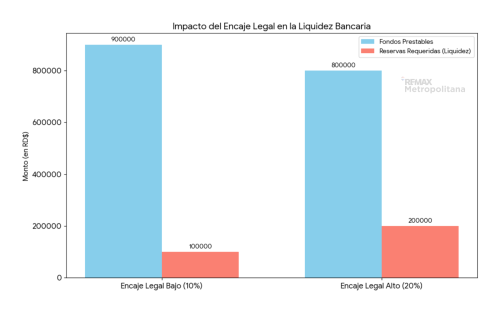
As the graphic shows, an increase in the legal reserve requirement forces banks to immobilize more resources, which reduces their available liquidity for loans. On the contrary, a decrease in the legal reserve requirement frees up funds, increasing the liquidity the bank has to lend and stimulate the economy.
What happens to inflation and growth?
As the saying goes: "a word to the wise is enough."
- High reserve = less money circulating = lower inflation
- Low reserve = more money circulating = more consumption and investment
The Central Bank adjusts the legal reserve requirement according to how the economy is doing: if there’s a lot of inflation, it raises it; if there’s recession or low growth, it lowers it. It’s that simple!
And in the Real Estate Market?
Now we get to the heart of the matter, or in other words, to what really interests you if you’re thinking about buying a house, constructing a building or investing in a real estate project.
If you’ve ever wondered about the factors that affect interest rates in the DR, the legal reserve requirement is one of the most direct. Here’s how it has an influence:
- Influence on mortgage interest rates. A high legal reserve requirement means banks have fewer resources available; consequently, interest rates will rise, including mortgage rates. You’ll pay more for the same loan. Conversely, a low reserve makes credit easier and pushes rates down. A good time to apply for a mortgage. If you’re interested in getting a mortgage, we invite you to prepare with our guide to applying for a mortgage loan.
- Ease of obtaining financing. Banks are more careful when they have less money available. If the reserve is high, they’ll demand more collateral, higher rates or outright reject applications that they would have approved at another time. When the reserve drops, banks are more willing to lend. There’s more competition among them and better conditions for the client.
- Impact on real estate financing in the Dominican Republic: Developers and builders depend directly on bank credit to start their projects. If the reserve is high, banks lend them less or with tougher conditions. This can slow down or halt new projects. On the other hand, a low reserve stimulates the development of new homes, towers, residential complexes, commercial plazas, etc.

Practical examples
- Bank with a high reserve. Suppose the legal reserve requirement is 12%. Bank ABC receives RD$1,000 million in deposits. It has to keep RD$120 million at the Central Bank and can only lend RD$880 million. Less money available = fewer loans = higher rates = less access to credit.
- Bank with a low reserve. Now let’s say the reserve drops to 8%. The bank only keeps RD$80 million and can lend RD$920 million. More loans = lower rates = more clients happy with their approved mortgage.
- Example with a mortgage. Someone wants to buy their first apartment for RD$4 million. With a high legal reserve requirement, the bank offers them a rate of 13% per year and many conditions. But when the reserve drops, the same bank offers them 9% per year and less paperwork. The difference in the monthly payment can amount to thousands of pesos.
And Who Should Care About All This?
Well, obviously, you! Whether you want to buy, sell, build, invest or simply understand why banks behave the way they do.
If you’re a buyer
- The legal reserve requirement affects how much you can finance and how much you’ll pay for your loan.
- It’s useful to keep an eye on the Central Bank’s announcements about changes to the reserve.
If you’re a developer
- You need to know whether the market will have access to credit.
- A low-reserve environment favors new projects and housing demand.
If you’re an investor
- The legal reserve requirement gives you clues about the future behavior of the real estate market.
- It can help you decide whether it’s time to get in or to wait.
How to Monitor It?
You can follow the website of the Central Bank of the Dominican Republic or its bulletins. Local economic media also usually report it when there are important changes.
As you’ve seen, the legal reserve requirement is a key market signal. Understanding it gives you an advantage, but having an expert on your side guarantees that you make the right decision at the right time. If you’re thinking about investing or applying for financing, contact us. We analyze the state of the market for you and guide you so you get the best possible conditions through our financial partners.